
Perseverance Heard a Dust Devil on Mars, and Now You Can Too

For years, we’ve seen images from various Mars rovers and landers of dust devils churning across the dusty landscape of the Red Planet. But now, thanks to a microphone on the Perseverance rover and a whirling dust storm that passed directly over the rover, we know what a dust devil on Mars sounds like, too.

Perseverance is equipped with a microphone on the SuperCam laser-zapping science instrument. When SuperCam blasts a rock, the resulting sounds give scientists clues about the rock’s composition. But one of the most anticipated uses of the microphone was the ability to hear the sounds of Mars itself.

“We can learn a lot more using sound than we can with some of the other tools,” said Roger Wiens, the principal investigator of SuperCam, from Purdue University.  “The microphone lets us sample, not quite at the speed of sound, but nearly 100,000 times a second. It helps us get a stronger sense of what Mars is like.”

This video shows the original images taken of the direct dust devil encounter by the the rover’s Navigation Camera (Navcam) and the images that have been processed to show the quantity of dust.The sound has been prepared for public release by R. Lapeyre (CNES). Credit: NASA/JPL-Caltech/LANL/CNES/CNRS/INTA-CSIC/Space Science Institute/ISAE-SUPAERO. The original video from NASA can be found here.

Dust devils are by no means a rare event, as it appears the Perseverance rover sees dust devils several times a day. A paper from earlier this year detailed the first 216 days of Perseverance’s mission in Jezero Crater and reported how the newest rover on Mars appears to be located in a “dust storm track” that runs north to south across the planet. Jezero Crater has particularly high levels of dust and wind activity. However, this is the first time the microphone was on when a dust devil passed over the rover.

To save data and power, the microphone is not always on. It records for about three minutes every couple of days. By chance, the SuperCam mic was turned back on September 27, 2021 just as a dust devil hoovered over Perseverance. The audio has about 10 seconds gusty winds – which the researchers estimate at about 40 kph (25 mph) — as well as the pinging of hundreds of dust particles hitting the rover.
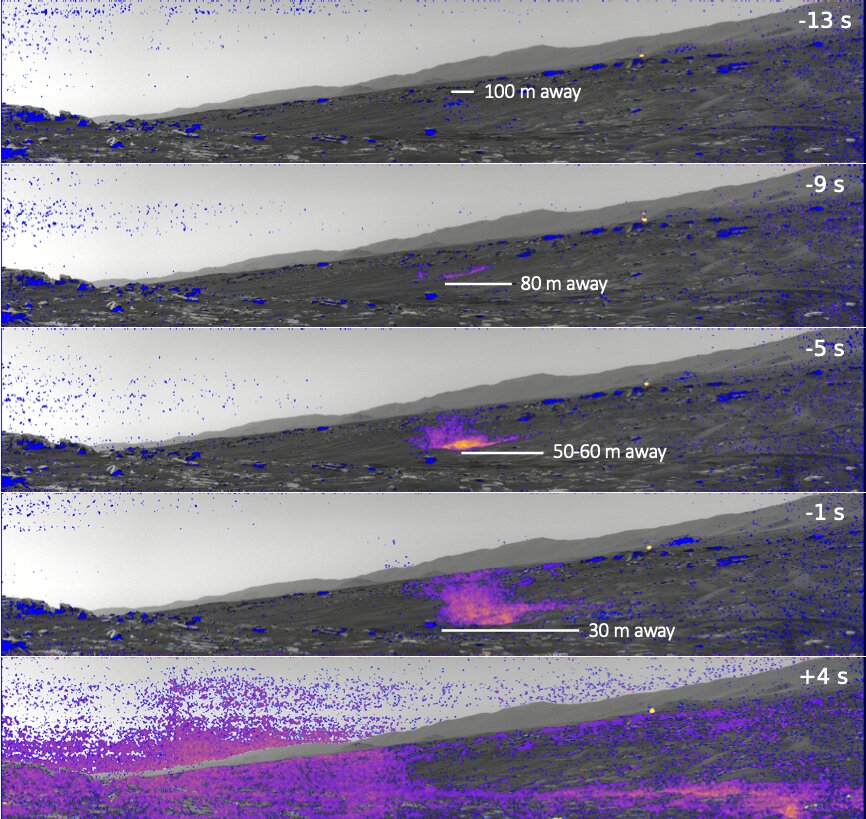
These are images taken of the direct dust devil encounter by the the rover’s Navigation Camera (Navcam). The images have been processed to show the quantity of dust. The colour scale ranges from lowest dust content (blue) to highest dust content (yellow).    Credit: NASA/JPL-Caltech/Space Science Institute/ISAE-SUPAERO

Planetary scientist Naomi Murdoch and a team of researchers at the National Higher French Institute of Aeronautics and Space and NASA published their dust devil finding in Nature Communications. They said the dust devil encounter was also simultaneously imaged by the Perseverance rover’s Navigation Camera and observed by several sensors in the Mars Environmental Dynamics Analyzer instrument.

“Combining these unique multi-sensorial data with modelling, we show that the dust devil was around 25?meters large, at least 118?meters tall, and passed directly over the rover traveling at approximately 5?meters per second,” they reported. ?

The sound recording of the dust devil, taken together with air pressure readings and time-lapse photography, help scientists understand the Martian atmosphere and weather.

“We could watch the pressure drop, listen to the wind, then have a little bit of silence that is the eye of the tiny storm, and then hear the wind again and watch the pressure rise,” Wiens said in a press release.

It all happened in a few seconds.
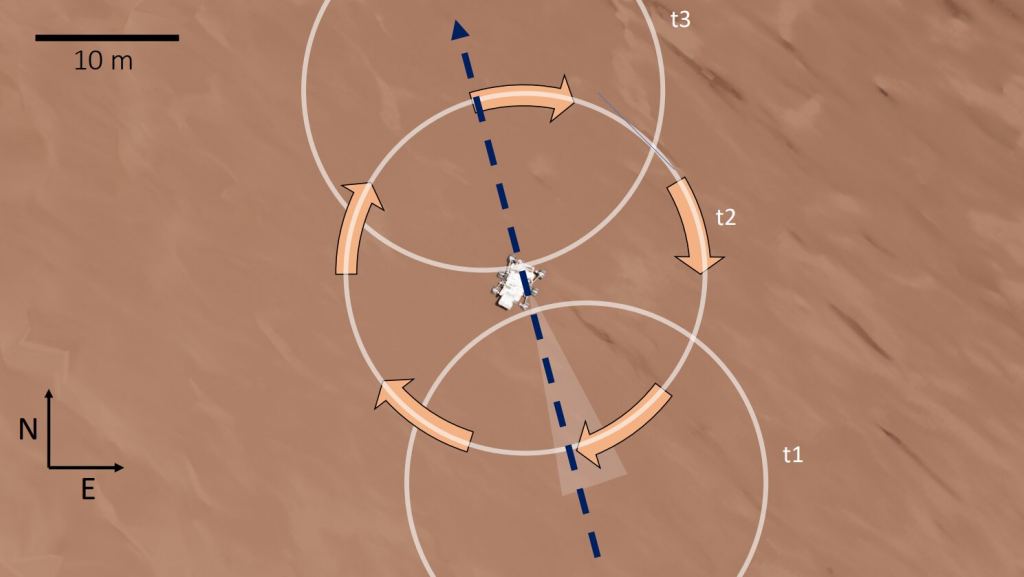
This figure shows the relative size of the dust devil with respect to the Perseverance rover. The dust devil diameter (white circles), determined from combined data and modelling, is 25 m.  The blue dashed arrow shows the dust devil trajectory direction. The rover Navigation camera (Navcam) field of view is indicated by the pale triangle. At t1 Perseverance is in the leading vortex wall, at t2 Perseverance is inside the eye of the vortex, and at t3 Perseverance is in the tailing vortex wall. The vortex and the rover are drawn to scale. The orange arrows indicate the clockwise rotational direction of the vortex winds. Credit: N. Murdoch / ISAE-SUPAERO

“The wind is fast—about 25 miles per hour, but about what you would see in a dust devil on Earth,” Weins said. “The difference is that the air pressure on Mars is so much lower that the winds, while just as fast, push with about 1% of the pressure the same speed of wind would have back on Earth. It’s not a powerful wind, but clearly enough to loft particles of grit into the air to make a dust devil.”

Since Perseverance is nuclear-powered, the rover team doesn’t have to worry about dust collecting on any solar panels and impacting the mission, like previous rovers such as Spirit and Opportunity. But it appears there is more dust lifting into the air in Jezero Crater.

Meanwhile, about 3,452 km (2,145 miles) away the Mars InSight mission will be shut down soon because dust has covered the solar panels. Researchers have reported a of wind and dust devils in the Elysium Planitia where the InSight lander sits.

“Just like Earth, there is different weather in different areas on Mars,” Wiens said. “Using all of our instruments and tools, especially the microphone, helps us get a concrete sense of what it would be like to be on Mars.”

The post Perseverance Heard a Dust Devil on Mars, and Now You Can Too appeared first on Universe Today.


from Universe Today https://ift.tt/9mqMP85
via IFTTT

Comments

Popular posts from this blog

More Data and Machine Learning has Kicked SETI Into High Gear

For over sixty years, astronomers and astrophysicists have been engaged in the Search for Extraterrestrial Intelligence (SETI). This consists of listening to other star systems for signs of technological activity (or “technosignatures), such as radio transmissions. This first attempt was in 1960, known as Project Ozma, where famed SETI researcher Dr. Frank Drake (father of the Drake Equation) and his colleagues used the Robert C. Byrd Green Bank Telescope in West Virginia to conduct a radio survey of Tau Ceti and Epsilon Eridani. Since then, the vast majority of SETI surveys have similarly looked for narrowband radio signals since they are very good at propagating through interstellar space. However, the biggest challenge has always been how to filter out radio transmissions on Earth – aka. radio frequency interference (RFI). In a recent study, an international team led by the Dunlap Institute for Astronomy and Astrophysics (DIAA) applied a new deep-learning algorithm to data collecte...

eROSITA Sees Changes in the Most Powerful Quasar

After almost seventy years of study, astronomers are still fascinated by active galactic nuclei (AGN), otherwise known as quasi-stellar objects (or “quasars.”) These are the result of supermassive black holes (SMBHs) at the center of massive galaxies, which cause gas and dust to fall in around them and form accretion disks. The material in these disks is accelerated to close to the speed of light, causing it to release tremendous amounts of radiation in the visible, radio, infrared, ultraviolet, gamma-ray, and X-ray wavelengths. In fact, quasars are so bright that they temporarily outshine every star in their host galaxy’s disk combined. The brightest quasar observed to date, 100,000 billion times as luminous as our Sun, is known as SMSS J114447.77-430859.3 (J1144). This AGN is hosted by a galaxy located roughly 9.6 billion light years from Earth between the constellations Centaurus and Hydra. Using data from the eROSITA All Sky Survey and other space telescopes, an international t...

Planetary Surfaces: Why study them? Can they help us find life elsewhere?

Universe Today recently explored the importance of studying impact craters and what they can teach us about finding life beyond Earth. Impact craters are considered one of the many surface processes—others include volcanism, weathering, erosion, and plate tectonics—that shape surfaces on numerous planetary bodies, with all of them simultaneously occurring on Earth. Here, we will explore how and why planetary scientists study planetary surfaces, the challenges faced when studying other planetary surfaces, what planetary surfaces can teach us about finding life, and how upcoming students can pursue studying planetary surfaces, as well. So, why is it so important to study planetary surfaces throughout the solar system? “Planetary surfaces record the history of the Solar System, a history that’s almost entirely lost to us here on Earth,” Dr. Paul Byrne, who is an Associate Professor of Earth, Environmental, and Planetary Sciences at Washington University in St. Louis, tells  Uni...