Even though Venus is very similar to Earth in many ways, it’s a hell-world with a runaway greenhouse effect. It was assumed this was because it lacked plate tectonics like Earth to sequester carbon inside the planet. A new study suggests that the high nitrogen and argon in its atmosphere are evidence from outgassing when it had plate tectonics billions of years ago. This could mean that Venus was habitable for a long time before something went horribly wrong.
Scientists have long tried to understand why Venus’ crushing carbon dioxide atmosphere is 90 times as thick as Earth’s. Additionally, there is almost no water vapor, and temperatures hover around 462 degrees Celsius (864 degrees Fahrenheit).
But it might not have always been this way. Previous work on modeling the planet’s geologic past has indicated it was quite likely Venus may have had a shallow liquid-water ocean and habitable surface temperatures for up to 2 billion years of its early history.
So, what happened?
Researchers from Brown University used current atmospheric data from Venus and plugged that into a computer model to compare the present-day Venusian atmosphere to atmospheres generated by various long-term thermal–chemical–tectonic evolution models. What the model revealed is that the planet’s current atmosphere and surface pressure would only have been possible if plate tectonics was part of Venus’ history.
“The [current] Venusian atmosphere requires volcanic outgassing in an early phase of plate-tectonic-like activity,” the team wrote in their paper, published in Nature Astronomy. “Our findings indicate that Venus’s atmosphere results from a great climatic–tectonic transition, from an early phase of active lid tectonics that lasted for at least 1?Gyr [1 billion years], followed by the current stagnant lid-like mode of reduced outgassing rates.”
“Stagnant lid” means its surface has only a single plate with minimal amounts of give, movement and gasses being released into the atmosphere.

The researchers modeled what would have had to happen on the planet to get to where it is today. They eventually were able to match the numbers almost exactly when they accounted for limited tectonic movement early in Venus’ history followed by the stagnant lid model that exists today.
They theorize that Venus must have had plate tectonics sometime after the planet formed, about 4.5 billion to 3.5 billion years ago. The paper suggests that this early tectonic movement, like on Earth, would have been limited, in terms of the number of plates moving and in how much they shifted.
But somehow, the paper suggests, Venus eventually became too hot and its atmosphere too thick, and the necessary conditions and ingredients for tectonic movement were lost.
Comparatively, the movement of the plates in Earth’s crust increased over billions of years, forming new continents and mountains, and leading to chemical reactions that stabilized the planet’s surface temperature, resulting in an environment more conducive to the development of life.
“One of the big picture takeaways is that we very likely had two planets at the same time in the same solar system operating in a plate tectonic regime — the same mode of tectonics that allowed for the life that we see on Earth today,” said Matt Weller in a press release from Brown University. Weller is the study’s lead author who completed the work while he was a postdoctoral researcher at Brown and is now at the Lunar and Planetary Institute in Houston.
But something must have been different on Venus for the action of plate tectonics to cease.
“Venus basically ran out of juice to some extent, and that put the brakes on the process,” said Daniel Ibarra, a professor in Brown’s Department of Earth, Environmental and Planetary Sciences and co-author on the paper.
While there is more work to be done on verifying the outcomes of this model, this work might also change the current thinking on planetary evolution.
“We’ve so far thought about tectonic state in terms of a binary: it’s either true or it’s false, and it’s either true or false for the duration of the planet,” said study co-author Alexander Evans, an assistant professor of Earth, environmental and planetary sciences at Brown. “This shows that planets may transition in and out of different tectonic states and that this may actually be fairly common. Earth may be the outlier. This also means we might have planets that transition in and out of habitability rather than just being continuously habitable.”
This work also shows that there are multiple ways to take a look back at a planet’s history.
“We’re still in this paradigm where we use the surfaces of planets to understand their history,” Evans said. “We really show for the first time that the atmosphere may actually be the best way to understand some of the very ancient history of planets that is often not preserved on the surface.”
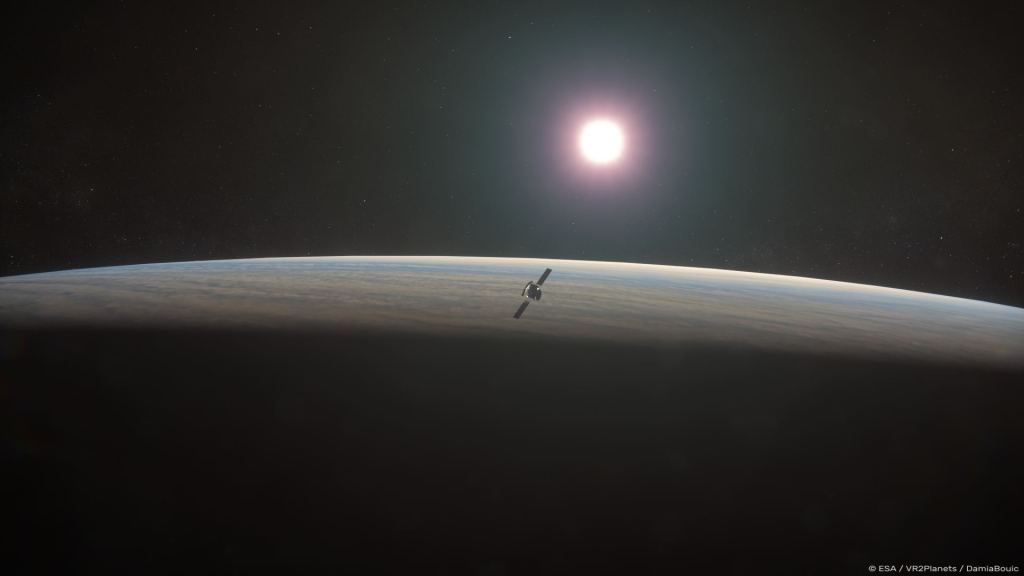
Upcoming missions to Venus should help clarify these findings. NASA’s DAVINCI (Deep Atmosphere Venus Investigation of Noble gases, Chemistry and Imaging) will measure gasses in the Venusian atmosphere. ESA’s EnVision spacecraft will peer through the planet’s thick atmosphere from orbit with a high-resolution radar.
DAVINCI is slated to launch in 2029, and EnVision will launch between 2035 to 2039.
The post Venus Might Have Had Plate Tectonics Just Like Earth appeared first on Universe Today.
from Universe Today https://ift.tt/OfzaS9m
via IFTTT
Comments
Post a Comment