Astronomers are Closing in on the Source of Galactic Cosmic Rays

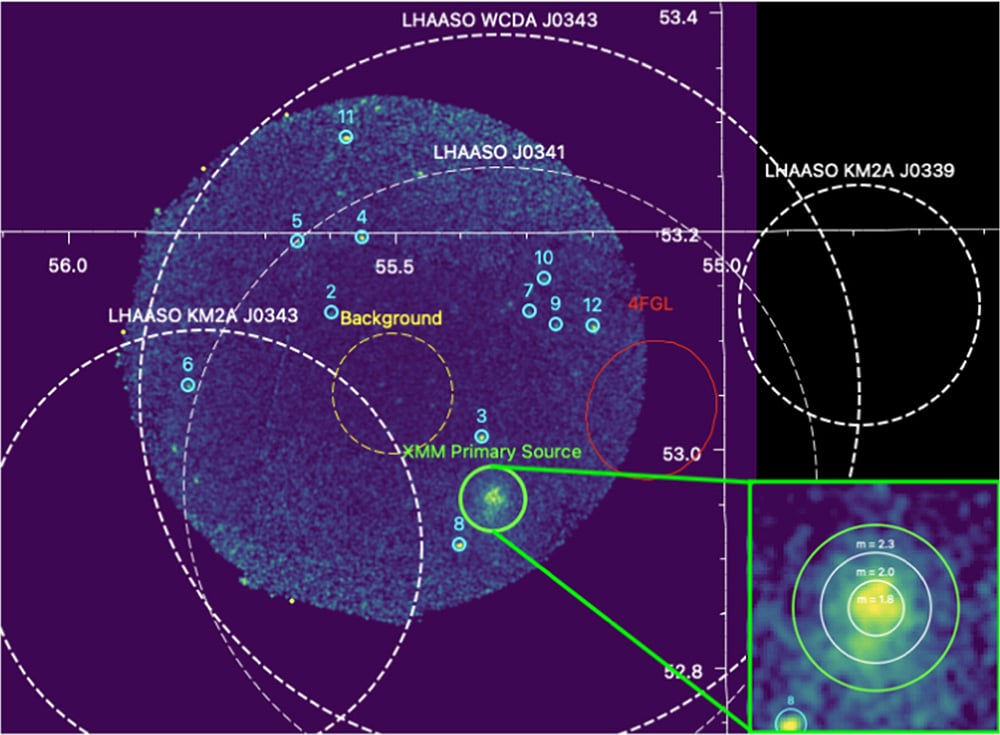
X-ray image of the newly discovered pulsar wind nebula associated with an extreme Galactic cosmic ray source 1LHAASO J0343+5254u. The data for this image were obtained by the XMM-Newton space telescope. Credit: XMM-Newton space telescope

In 1912, astronomer Victor Hess discovered strange, high-energy particles called "cosmic rays." Since then, researchers have hunted for their birthplaces. Today, we know about some of the cosmic ray "launch pads", ranging from the Sun and supernova explosions to black holes and distant active galactic nuclei. What astronomers are now searching are sources of cosmic rays within the Milky Way Galaxy. One such source is a pulsar wind nebula sending high-energy particles out to space.


from Universe Today https://ift.tt/pTv16ek
via IFTTT

Comments

Popular posts from this blog

Researchers Match Up 12 Meteorites with the Near-Earth Asteroids They Came From

Every day meteoroids blast through our planet’s atmosphere to hit the ground as meteorites. A team of researchers in Italy traced twelve of them to progenitor asteroids that orbit in near-Earth space. Scientists treasure meteorites because they reveal information about their parent bodies. In an arXiv paper, two Italian researchers—Albino Carbognani and Marco Fenucci—analyze the characteristics of the parent bodies of 20 selected meteorites. They were able to track all but eight back to their parent asteroids. Based on their work, the pair says at least a quarter of meteorites come from collisions that happened in near-Earth space and not in the Main Belt. Meteorites from Near-Earth Asteroids: How They Got Here Many meteorites are chondritic, similar to asteroids in the Main Belt (or came from it). In their paper, the authors point out that progenitor meteoroids (including many that fall to Earth and become meteorites) formed millions of years ago following collisions between main-...

More Data and Machine Learning has Kicked SETI Into High Gear

For over sixty years, astronomers and astrophysicists have been engaged in the Search for Extraterrestrial Intelligence (SETI). This consists of listening to other star systems for signs of technological activity (or “technosignatures), such as radio transmissions. This first attempt was in 1960, known as Project Ozma, where famed SETI researcher Dr. Frank Drake (father of the Drake Equation) and his colleagues used the Robert C. Byrd Green Bank Telescope in West Virginia to conduct a radio survey of Tau Ceti and Epsilon Eridani. Since then, the vast majority of SETI surveys have similarly looked for narrowband radio signals since they are very good at propagating through interstellar space. However, the biggest challenge has always been how to filter out radio transmissions on Earth – aka. radio frequency interference (RFI). In a recent study, an international team led by the Dunlap Institute for Astronomy and Astrophysics (DIAA) applied a new deep-learning algorithm to data collecte...

What Blew Up the Local Bubble?

In our neighborhood of the Milky Way, we see a region surrounding the solar system that is far less dense than average. But that space, that cavity, is a very irregular, elongated shape. What little material is left inside of this cavity is insanely hot, as it has a temperature of around a million Kelvin. from Universe Today https://ift.tt/KvVDeiC via IFTTT