The Milky Way Could be Surrounded by 100 Satellite Galaxies

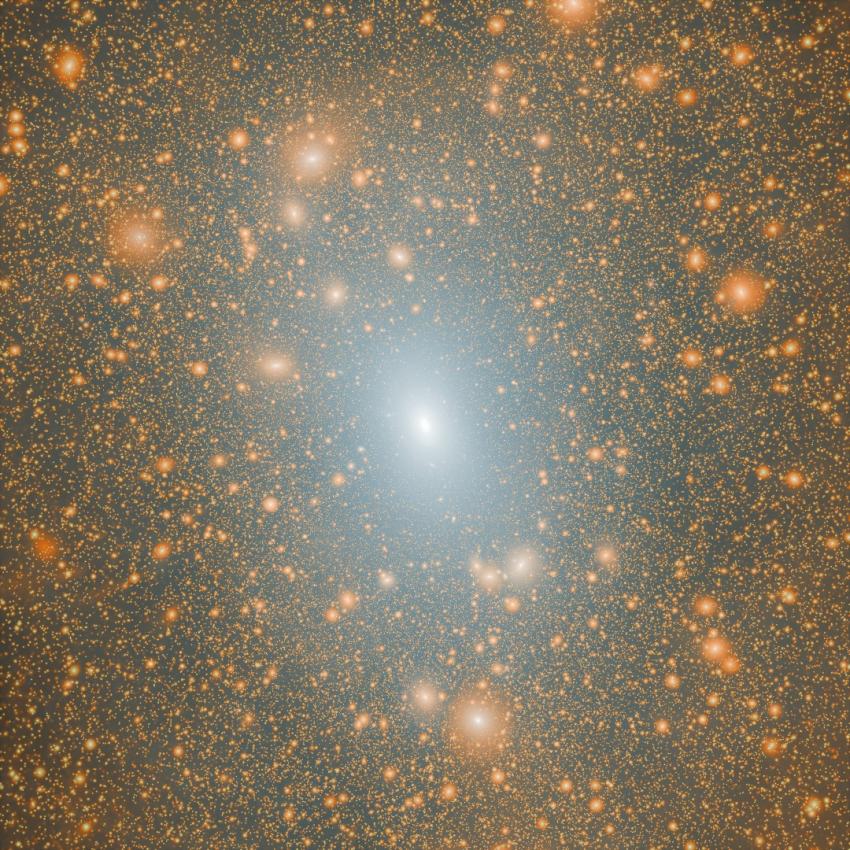
The dark matter distribution of a Milky Way mass halo in a Lambda-cold dark matter (LCDM) cosmological simulation. This is the highest resolution simulation of a MW-mass dark matter halo ever performed, called Aquarius-A-L1. The MW halo (in the centre) is surrounded by myriad substructures, a key prediction of the "cold dark matter” model. Some of these subhalos host a satellite galaxy within them that could be observable. Credit The Aquarius simulation, the Virgo Consortium/Dr Mark Lovell

The Milky Way is surrounded by about 60 satellite galaxies. The famous ones are the Large and Small Magellanic Clouds. But according to a new simulation, the Milky Way could have 80 and even 100 satellite galaxies that we haven't detected so far. These galaxies will be hard to find. They've had most of their mass stripped by the gravity of the Milky Way's halo. But new telescopes like Vera Rubin should be able to spot them.


from Universe Today https://ift.tt/9pofePR
via IFTTT

Comments

Popular posts from this blog

More Data and Machine Learning has Kicked SETI Into High Gear

For over sixty years, astronomers and astrophysicists have been engaged in the Search for Extraterrestrial Intelligence (SETI). This consists of listening to other star systems for signs of technological activity (or “technosignatures), such as radio transmissions. This first attempt was in 1960, known as Project Ozma, where famed SETI researcher Dr. Frank Drake (father of the Drake Equation) and his colleagues used the Robert C. Byrd Green Bank Telescope in West Virginia to conduct a radio survey of Tau Ceti and Epsilon Eridani. Since then, the vast majority of SETI surveys have similarly looked for narrowband radio signals since they are very good at propagating through interstellar space. However, the biggest challenge has always been how to filter out radio transmissions on Earth – aka. radio frequency interference (RFI). In a recent study, an international team led by the Dunlap Institute for Astronomy and Astrophysics (DIAA) applied a new deep-learning algorithm to data collecte...

The First Close-Up Picture of Star Outside the Milky Way

Like a performer preparing for their big finale, a distant star is shedding its outer layers and preparing to explode as a supernova. Astronomers have been observing the huge star, named WOH G64, since its discovery in the 1970s. It’s one of the largest known stars, and also one of the most luminous and massive red supergiants (RSGs). The star is surrounded by an envelope of expelled star-stuff, which could indicate it’s getting ready to explode. WOH G64 isn’t in the Milky Way; it’s in the Large Magellanic Cloud (LMC), the Milky Way’s largest satellite galaxy. Getting these detailed image is quite a feat for the ESO’s Very Large Telescope Interferometer. It’s also quite an accomplishment for the team of scientists behind the image. They’ve published their images and the results of their observations of the star in the journal Astronomy and Astrophysics. Their research is titled “ Imaging the innermost circumstellar environment of the red supergiant WOH G64 in the Large Magellanic ...

Planetary Surfaces: Why study them? Can they help us find life elsewhere?

Universe Today recently explored the importance of studying impact craters and what they can teach us about finding life beyond Earth. Impact craters are considered one of the many surface processes—others include volcanism, weathering, erosion, and plate tectonics—that shape surfaces on numerous planetary bodies, with all of them simultaneously occurring on Earth. Here, we will explore how and why planetary scientists study planetary surfaces, the challenges faced when studying other planetary surfaces, what planetary surfaces can teach us about finding life, and how upcoming students can pursue studying planetary surfaces, as well. So, why is it so important to study planetary surfaces throughout the solar system? “Planetary surfaces record the history of the Solar System, a history that’s almost entirely lost to us here on Earth,” Dr. Paul Byrne, who is an Associate Professor of Earth, Environmental, and Planetary Sciences at Washington University in St. Louis, tells  Uni...