Could We Launch a Mission to Chase Down Interstellar Comet 3I/ATLAS?

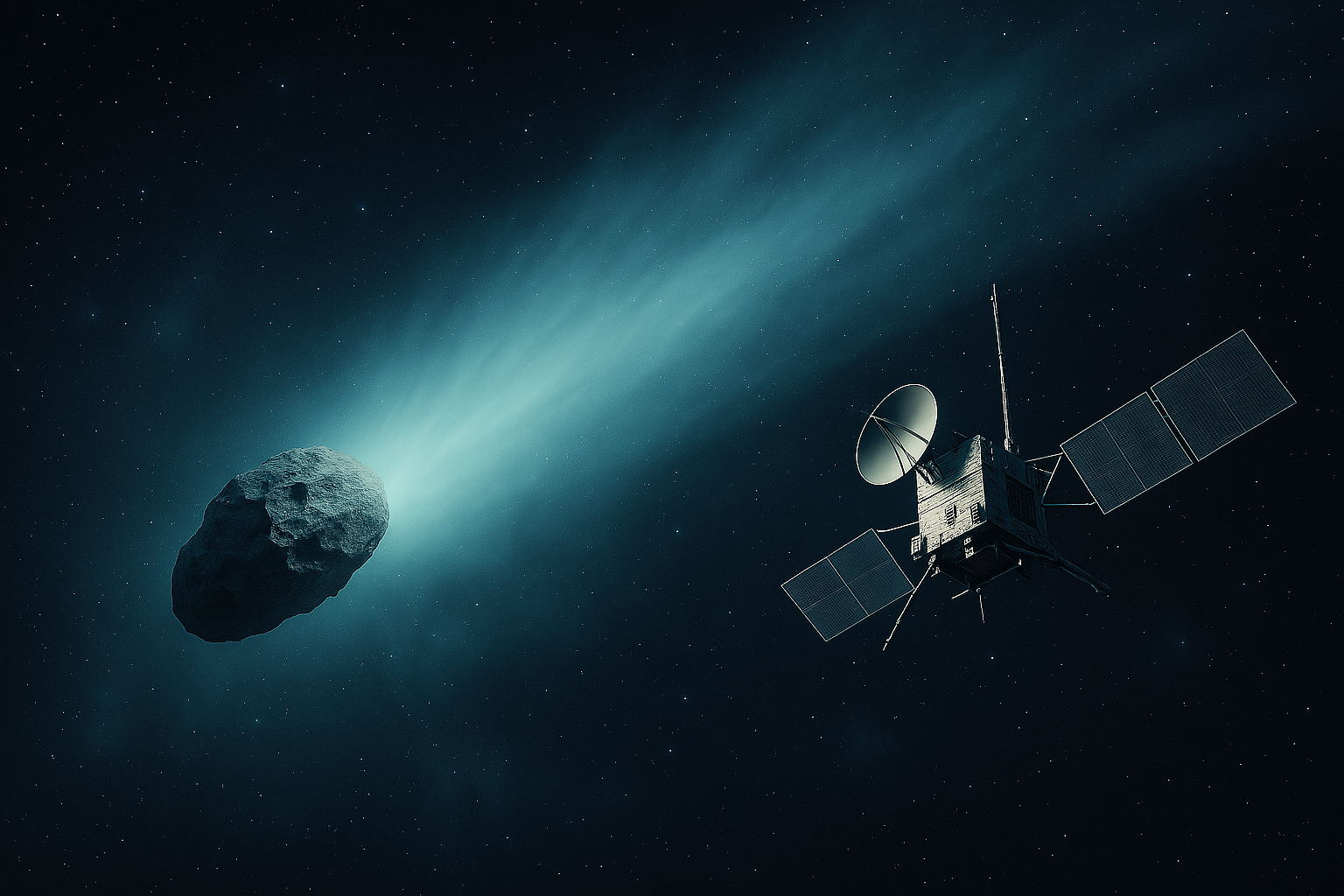
A hypothetical mission to intercept an interstellar comet. Created by the author using Copilot AI.

It’s a tantalizing prospect. Since 2017, three interstellar objects have been spotted passing through our solar system: 1I/ʻOumuamua, 2I/Borisov… and just this month, 3I/ATLAS. Discovered on July 1st by the Asteroid Terrestrial-impact Last Alert Survey, 3I/ATLAS is zipping through the inner solar system in the last half of 2025. Certainly, all assets on the ground and in space will be turned towards 3I/ATLAS over the next few frenzied months, to glean what we can… but what would 3I/ATLAS look like up close? Can we even consider chasing down such a speedy visitor?


from Universe Today https://ift.tt/HAho7wC
via IFTTT

Comments

Popular posts from this blog

More Data and Machine Learning has Kicked SETI Into High Gear

For over sixty years, astronomers and astrophysicists have been engaged in the Search for Extraterrestrial Intelligence (SETI). This consists of listening to other star systems for signs of technological activity (or “technosignatures), such as radio transmissions. This first attempt was in 1960, known as Project Ozma, where famed SETI researcher Dr. Frank Drake (father of the Drake Equation) and his colleagues used the Robert C. Byrd Green Bank Telescope in West Virginia to conduct a radio survey of Tau Ceti and Epsilon Eridani. Since then, the vast majority of SETI surveys have similarly looked for narrowband radio signals since they are very good at propagating through interstellar space. However, the biggest challenge has always been how to filter out radio transmissions on Earth – aka. radio frequency interference (RFI). In a recent study, an international team led by the Dunlap Institute for Astronomy and Astrophysics (DIAA) applied a new deep-learning algorithm to data collecte...

SETI Researchers Double-Checked 1 Million Objects for Signs of Alien Signals

We can’t help ourselves but wonder about life elsewhere in the Universe. Any hint of a biosignature or even a faint, technosignature-like event wrests our attention away from our tumultuous daily affairs. In 1984, our wistful quest took concrete form as SETI, the Search for Extraterrestrial Intelligence . Unfortunately, or maybe fortunately, SETI has turned up nothing. Recently, scientists used a powerful new data system to re-examine data from one million cosmic objects and still came up empty-handed. Did they learn anything from this attempt? This effort used COSMIC , which stands for  Commensal Open-Source Multimode Interferometer Cluster . It’s a signal-processing and algorithm system attached to the Karl G. Jansky  Very Large Array  (VLA) radio astronomy observatory. According to SETI, it’s designed to “search for signals throughout the Galaxy consistent with our understanding of artificial radio emissions. “ Modern astronomy generates vast volumes of data and al...