
Luminous Fast Blue Optical Transients Are Likely Large Black Holes Shredding Their Massive Companions
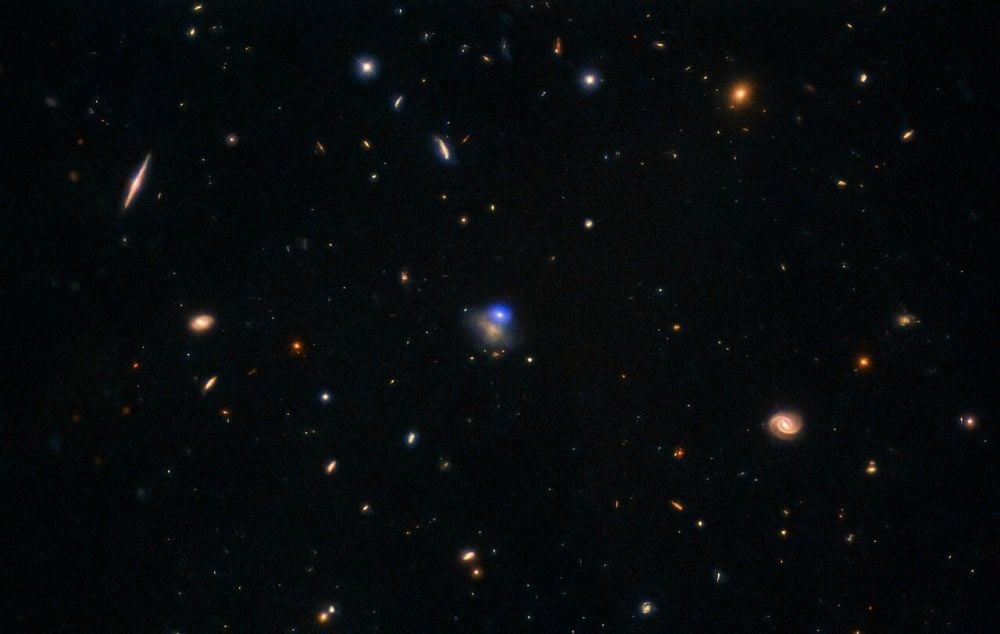
This composite image features X-ray, ultraviolet, optical, and near-infrared data of the luminous fast blue optical transient (LFBOT) named AT 2024wpp. The transient is the bright spot at the upper right edge of its host galaxy, which is 1.1 billion light-years from Earth. Astrophysicists have puzzled over these objects for more than a decade, but may have finally figured out what causes them. Image Credit: International Gemini Observatory/NOIRLab/NSF/AURA Image Processing: J. Miller (International Gemini Observatory/NSF NOIRLab), T.A. Rector (University of Alaska Anchorage/NSF NOIRLab), M. Zamani & D. de Martin (NSF NOIRLab)

In 2024, astronomers discovered the brightest Luminous Fast Blue Optical Transient (LFBOT) ever observed. LFBOTs are extremely bright flashes of blue light that shine for brief periods before fading away. New analysis of this record-breaking burst, which includes observations from the International Gemini Observatory, funded in part by the U.S. National Science Foundation, challenges all prior understanding of these rare explosive events.


from Universe Today https://ift.tt/bpBfGO7
via IFTTT

Comments

Popular posts from this blog

SETI Researchers Double-Checked 1 Million Objects for Signs of Alien Signals

We can’t help ourselves but wonder about life elsewhere in the Universe. Any hint of a biosignature or even a faint, technosignature-like event wrests our attention away from our tumultuous daily affairs. In 1984, our wistful quest took concrete form as SETI, the Search for Extraterrestrial Intelligence . Unfortunately, or maybe fortunately, SETI has turned up nothing. Recently, scientists used a powerful new data system to re-examine data from one million cosmic objects and still came up empty-handed. Did they learn anything from this attempt? This effort used COSMIC , which stands for  Commensal Open-Source Multimode Interferometer Cluster . It’s a signal-processing and algorithm system attached to the Karl G. Jansky  Very Large Array  (VLA) radio astronomy observatory. According to SETI, it’s designed to “search for signals throughout the Galaxy consistent with our understanding of artificial radio emissions. “ Modern astronomy generates vast volumes of data and al...

Do Dwarf Galaxies Merge In The Milky Way's Halo?

Our current understanding of the Cosmos shows that structures emerge hierarchically. First there are dark matter densities, then dwarf galaxies. Those dwarfs then merge to form more massive galaxies, which merge together into even larger galaxies. Evidence of dwarf galaxy mergers is difficult to obtain, but new research found some in the Milky Way's halo. from Universe Today https://ift.tt/DXpfOim via IFTTT

A Magnetohydrodynamic Drive Could Lead to Fuel Stations on Mars

Within the next fifteen years, NASA, China, and SpaceX plan to send the first crewed missions to Mars. In all three cases, these missions are meant to culminate in the creation of surface habitats that will allow for many returns and – quite possibly – permanent human settlements. This presents numerous challenges, one of the greatest of which is the need for plenty of breathable air and propellant. Both can be manufactured through electrolysis, where electromagnetic fields are applied to water (H 2 O) to create oxygen gas (O 2 ) and liquid hydrogen (LH 2 ). While Mars has ample deposits of water ice on its surface that make this feasible, existing technological solutions fall short of the reliability and efficiency levels required for space exploration. Fortunately, a team of researchers from Georgia Tech has proposed a “ Magnetohydrodynamic Drive for Hydrogen and Oxygen Production in Mars Transfer ” that combines multiple functionalities into a system with no moving parts. This syst...