The Unexpected Evolution Aboard the ISS

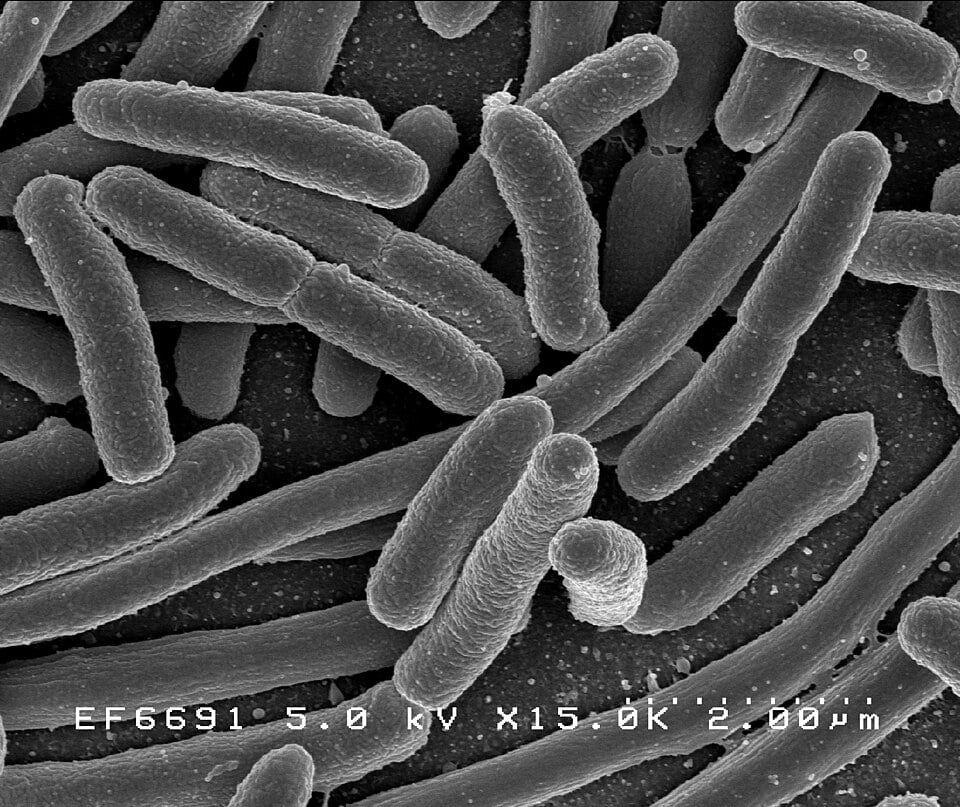
Scanning electron micrograph of E Coli, grown in culture and adhered to a cover slip. Such bacteria was used in a recent study on board the ISS (Credit: NIAID)

New research from the International Space Station reveals that in near weightless conditions, both bacteriophages and their *E. coli* hosts mutate in ways not seen on Earth. This unexpected finding not only deepens our understanding of how microbial life adapts to extreme environments but has already yielded practical benefits. Some of the mutations discovered in space dwelling viruses led researchers to create superior viruses that specifically infect and kill bacteria, capable of fighting drug resistant bacterial infections back on Earth.


from Universe Today https://ift.tt/uHF2fSb
via IFTTT

Comments

Popular posts from this blog

Do Dwarf Galaxies Merge In The Milky Way's Halo?

Our current understanding of the Cosmos shows that structures emerge hierarchically. First there are dark matter densities, then dwarf galaxies. Those dwarfs then merge to form more massive galaxies, which merge together into even larger galaxies. Evidence of dwarf galaxy mergers is difficult to obtain, but new research found some in the Milky Way's halo. from Universe Today https://ift.tt/DXpfOim via IFTTT

SETI Researchers Double-Checked 1 Million Objects for Signs of Alien Signals

We can’t help ourselves but wonder about life elsewhere in the Universe. Any hint of a biosignature or even a faint, technosignature-like event wrests our attention away from our tumultuous daily affairs. In 1984, our wistful quest took concrete form as SETI, the Search for Extraterrestrial Intelligence . Unfortunately, or maybe fortunately, SETI has turned up nothing. Recently, scientists used a powerful new data system to re-examine data from one million cosmic objects and still came up empty-handed. Did they learn anything from this attempt? This effort used COSMIC , which stands for  Commensal Open-Source Multimode Interferometer Cluster . It’s a signal-processing and algorithm system attached to the Karl G. Jansky  Very Large Array  (VLA) radio astronomy observatory. According to SETI, it’s designed to “search for signals throughout the Galaxy consistent with our understanding of artificial radio emissions. “ Modern astronomy generates vast volumes of data and al...

A New Technique Has Dramatically Improved ALMA’s Resolution

To those familiar with optical telescopes, the idea of doing something to achieve higher resolution with their telescope may seem alien, if not, then practically impossible. A telescopes resolution is determined by among other things, its aperture – diameter of the thing that collects light (or electromagnetic radiation) and of course you can’t easily change that. Enter the team at ALMA, the Atacama Large Millimeter Array who have become the first to use the Band 10 receiver and extreme separation of the receivers to boosting its resolution so they can see detail equivalent of detecting a 10 meter long bus on the Moon! The Atacama Large Millimeter/submillimeter Array (otherwise known as ALMA) is based upon interferometer technology which, in its simplest terms, takes a number of telescopes, hooks them together and gives them the same amount of resolution as if the instrument was the same diameter as the distance between the component parts! If that blew your mind then let me explain;...