Astronomers Search for "Exotrojans" Hiding in Extreme Pulsar Systems

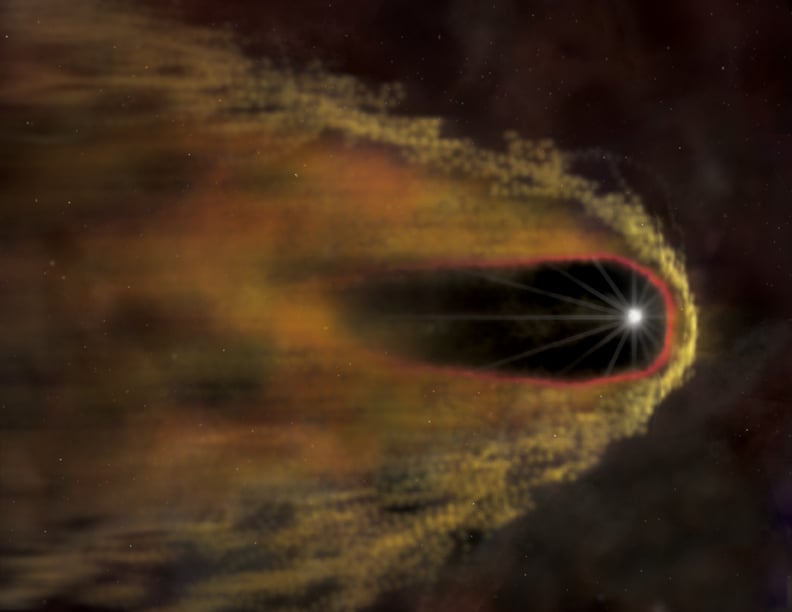
Artist's impression of pulsar B1957+20 - an example of a black widow. Credit - NASA/CXC/M.Weiss

Greek mythology has given a name to a great many objects in our solar system. But perhaps one of the least well understood are the Trojans, named after the people of Troy featured in The Iliad. When astronomers refer to them, they are normally talking about a group of over 10,000 confirmed asteroids orbiting at the Lagrange points both in front of and behind Jupiter on its orbit around the Sun. But, more generally, astronomers can now use the term to refer to any co-orbital setup - indeed almost every planet in our solar system has Trojans, though not as many as Jupiter. Which also leads to the belief that “exotrojans” must exist around other stars. Despite our best efforts with initiatives like the TROY project, so far we have yet to find one. But a new paper published in The Astrophysical Journal by Jackson Taylor of West Virginia University and an abundance of co-authors took the hunt to one of the most extreme environments in the universe: pulsar binary systems.


from Universe Today https://ift.tt/5fB3AI9
via IFTTT

Comments

Popular posts from this blog

More Data and Machine Learning has Kicked SETI Into High Gear

For over sixty years, astronomers and astrophysicists have been engaged in the Search for Extraterrestrial Intelligence (SETI). This consists of listening to other star systems for signs of technological activity (or “technosignatures), such as radio transmissions. This first attempt was in 1960, known as Project Ozma, where famed SETI researcher Dr. Frank Drake (father of the Drake Equation) and his colleagues used the Robert C. Byrd Green Bank Telescope in West Virginia to conduct a radio survey of Tau Ceti and Epsilon Eridani. Since then, the vast majority of SETI surveys have similarly looked for narrowband radio signals since they are very good at propagating through interstellar space. However, the biggest challenge has always been how to filter out radio transmissions on Earth – aka. radio frequency interference (RFI). In a recent study, an international team led by the Dunlap Institute for Astronomy and Astrophysics (DIAA) applied a new deep-learning algorithm to data collecte...

eROSITA Sees Changes in the Most Powerful Quasar

After almost seventy years of study, astronomers are still fascinated by active galactic nuclei (AGN), otherwise known as quasi-stellar objects (or “quasars.”) These are the result of supermassive black holes (SMBHs) at the center of massive galaxies, which cause gas and dust to fall in around them and form accretion disks. The material in these disks is accelerated to close to the speed of light, causing it to release tremendous amounts of radiation in the visible, radio, infrared, ultraviolet, gamma-ray, and X-ray wavelengths. In fact, quasars are so bright that they temporarily outshine every star in their host galaxy’s disk combined. The brightest quasar observed to date, 100,000 billion times as luminous as our Sun, is known as SMSS J114447.77-430859.3 (J1144). This AGN is hosted by a galaxy located roughly 9.6 billion light years from Earth between the constellations Centaurus and Hydra. Using data from the eROSITA All Sky Survey and other space telescopes, an international t...

Planetary Surfaces: Why study them? Can they help us find life elsewhere?

Universe Today recently explored the importance of studying impact craters and what they can teach us about finding life beyond Earth. Impact craters are considered one of the many surface processes—others include volcanism, weathering, erosion, and plate tectonics—that shape surfaces on numerous planetary bodies, with all of them simultaneously occurring on Earth. Here, we will explore how and why planetary scientists study planetary surfaces, the challenges faced when studying other planetary surfaces, what planetary surfaces can teach us about finding life, and how upcoming students can pursue studying planetary surfaces, as well. So, why is it so important to study planetary surfaces throughout the solar system? “Planetary surfaces record the history of the Solar System, a history that’s almost entirely lost to us here on Earth,” Dr. Paul Byrne, who is an Associate Professor of Earth, Environmental, and Planetary Sciences at Washington University in St. Louis, tells  Uni...