How Saving Earth Could Ruin Orbit

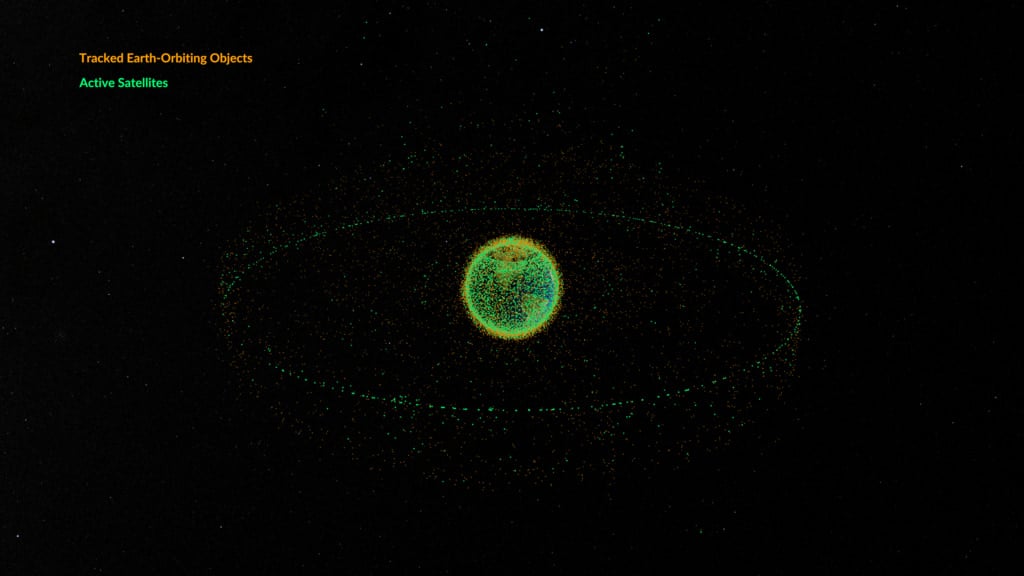
NASA visualization of satellites in orbit. Credit - NASA Scientific Visulization Studio / Kel Elkins / Jessica Ende / Charles Fisher / Christina Mitchell

Satellite imaging is increasingly important to every field from crop monitoring to poverty reduction. So it’s no surprise that there have been more and more satellites launched to try to meet that growing demand. But with more satellites comes more risk for collision - and the debris field that comes after the collision. A new paper in Advanced in Space Research from John Mackintosh and his co-authors at the University of Manchester looks at how we might use mission design to mitigate some of the hazards of increasing the number of satellites even more


from Universe Today https://ift.tt/saQonEf
via IFTTT

Comments

Popular posts from this blog

Researchers Match Up 12 Meteorites with the Near-Earth Asteroids They Came From

Every day meteoroids blast through our planet’s atmosphere to hit the ground as meteorites. A team of researchers in Italy traced twelve of them to progenitor asteroids that orbit in near-Earth space. Scientists treasure meteorites because they reveal information about their parent bodies. In an arXiv paper, two Italian researchers—Albino Carbognani and Marco Fenucci—analyze the characteristics of the parent bodies of 20 selected meteorites. They were able to track all but eight back to their parent asteroids. Based on their work, the pair says at least a quarter of meteorites come from collisions that happened in near-Earth space and not in the Main Belt. Meteorites from Near-Earth Asteroids: How They Got Here Many meteorites are chondritic, similar to asteroids in the Main Belt (or came from it). In their paper, the authors point out that progenitor meteoroids (including many that fall to Earth and become meteorites) formed millions of years ago following collisions between main-...

More Data and Machine Learning has Kicked SETI Into High Gear

For over sixty years, astronomers and astrophysicists have been engaged in the Search for Extraterrestrial Intelligence (SETI). This consists of listening to other star systems for signs of technological activity (or “technosignatures), such as radio transmissions. This first attempt was in 1960, known as Project Ozma, where famed SETI researcher Dr. Frank Drake (father of the Drake Equation) and his colleagues used the Robert C. Byrd Green Bank Telescope in West Virginia to conduct a radio survey of Tau Ceti and Epsilon Eridani. Since then, the vast majority of SETI surveys have similarly looked for narrowband radio signals since they are very good at propagating through interstellar space. However, the biggest challenge has always been how to filter out radio transmissions on Earth – aka. radio frequency interference (RFI). In a recent study, an international team led by the Dunlap Institute for Astronomy and Astrophysics (DIAA) applied a new deep-learning algorithm to data collecte...

Review: Unistellar’s New Odyssey Pro Smart Telescope

Unistellar’s new Odyssey Pro telescope offers access to deep-sky astrophotography in a small portable package. Access to the night sky has never been simpler. The last half decade has seen a revolution in backyard astronomy, as ‘smartscopes’—telescopes controlled by smartphone applications—have come to the fore. These offer an easy entry into basic deep sky astrophotography even from bright urban skies, albeit at a higher price point versus traditional telescopes on the market. We’ve reviewed units from Vaonis and Unistellar before, as well as wrote commentary on the rise of the whole smartscope movement . Now, Unistellar has a new entry on the market in 2024: the Odyssey Pro . The Odyssey Pro is lightweight, at 14.3-pounds (65 kilograms) assembled plus carbon fiber tripod. The telescope sets up quickly, with the tube and base securing to the top ring of the tripod. Specifications for the Odyssey Pro The telescope at the heart of the system is an 85mm aperture reflector with an ...