Scientists Spot a Solar Flare With Surprising Spectral Behavior

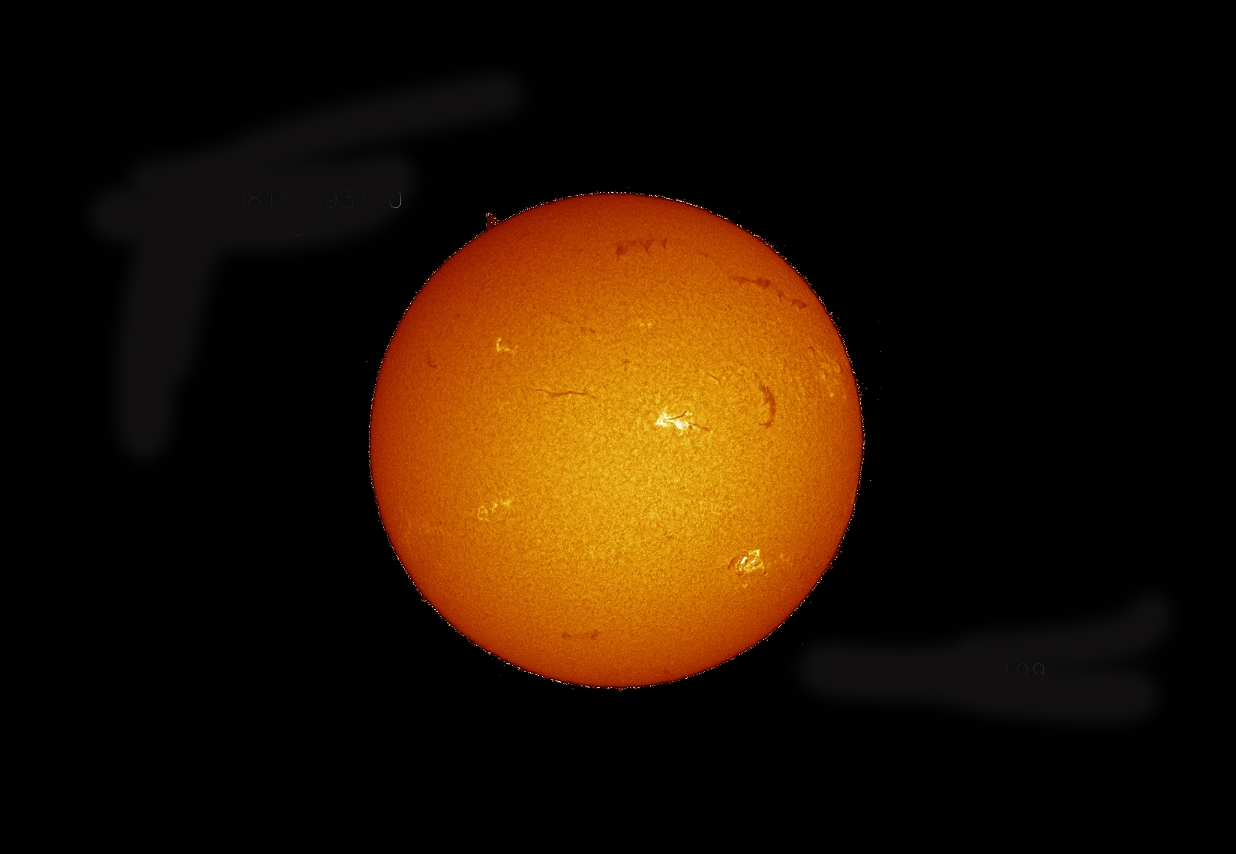
The Sun as it appeared in H-alpha on September 18, 2022. Solar physicists used the Daniel K. Inouye solar telescope to zero in on the active region at the lower right on September 19, 2022, at the end of a very busy week of solar activity. Courtesy CESAR Helios Observatory.

On August 19, 2022, astronomers using the Daniel K. Inouye Solar Telescope (DKIST) on the Hawaiian island of Maui caught the fading remnants of a C-class solar flare. Their observations showed something unusual: very strong spectral fingerprints of calcium II H and hydrogen-epsilon lines. It was the first time these two light signatures were seen in great detail during a flare. According to computer models, those lines were stronger than expected and play a not well-understood role in how flares heat the solar atmosphere where they occur.


from Universe Today https://ift.tt/f3KzLVm
via IFTTT

Comments

Popular posts from this blog

Researchers Match Up 12 Meteorites with the Near-Earth Asteroids They Came From

Every day meteoroids blast through our planet’s atmosphere to hit the ground as meteorites. A team of researchers in Italy traced twelve of them to progenitor asteroids that orbit in near-Earth space. Scientists treasure meteorites because they reveal information about their parent bodies. In an arXiv paper, two Italian researchers—Albino Carbognani and Marco Fenucci—analyze the characteristics of the parent bodies of 20 selected meteorites. They were able to track all but eight back to their parent asteroids. Based on their work, the pair says at least a quarter of meteorites come from collisions that happened in near-Earth space and not in the Main Belt. Meteorites from Near-Earth Asteroids: How They Got Here Many meteorites are chondritic, similar to asteroids in the Main Belt (or came from it). In their paper, the authors point out that progenitor meteoroids (including many that fall to Earth and become meteorites) formed millions of years ago following collisions between main-...

More Data and Machine Learning has Kicked SETI Into High Gear

For over sixty years, astronomers and astrophysicists have been engaged in the Search for Extraterrestrial Intelligence (SETI). This consists of listening to other star systems for signs of technological activity (or “technosignatures), such as radio transmissions. This first attempt was in 1960, known as Project Ozma, where famed SETI researcher Dr. Frank Drake (father of the Drake Equation) and his colleagues used the Robert C. Byrd Green Bank Telescope in West Virginia to conduct a radio survey of Tau Ceti and Epsilon Eridani. Since then, the vast majority of SETI surveys have similarly looked for narrowband radio signals since they are very good at propagating through interstellar space. However, the biggest challenge has always been how to filter out radio transmissions on Earth – aka. radio frequency interference (RFI). In a recent study, an international team led by the Dunlap Institute for Astronomy and Astrophysics (DIAA) applied a new deep-learning algorithm to data collecte...

SETI Researchers Double-Checked 1 Million Objects for Signs of Alien Signals

We can’t help ourselves but wonder about life elsewhere in the Universe. Any hint of a biosignature or even a faint, technosignature-like event wrests our attention away from our tumultuous daily affairs. In 1984, our wistful quest took concrete form as SETI, the Search for Extraterrestrial Intelligence . Unfortunately, or maybe fortunately, SETI has turned up nothing. Recently, scientists used a powerful new data system to re-examine data from one million cosmic objects and still came up empty-handed. Did they learn anything from this attempt? This effort used COSMIC , which stands for  Commensal Open-Source Multimode Interferometer Cluster . It’s a signal-processing and algorithm system attached to the Karl G. Jansky  Very Large Array  (VLA) radio astronomy observatory. According to SETI, it’s designed to “search for signals throughout the Galaxy consistent with our understanding of artificial radio emissions. “ Modern astronomy generates vast volumes of data and al...