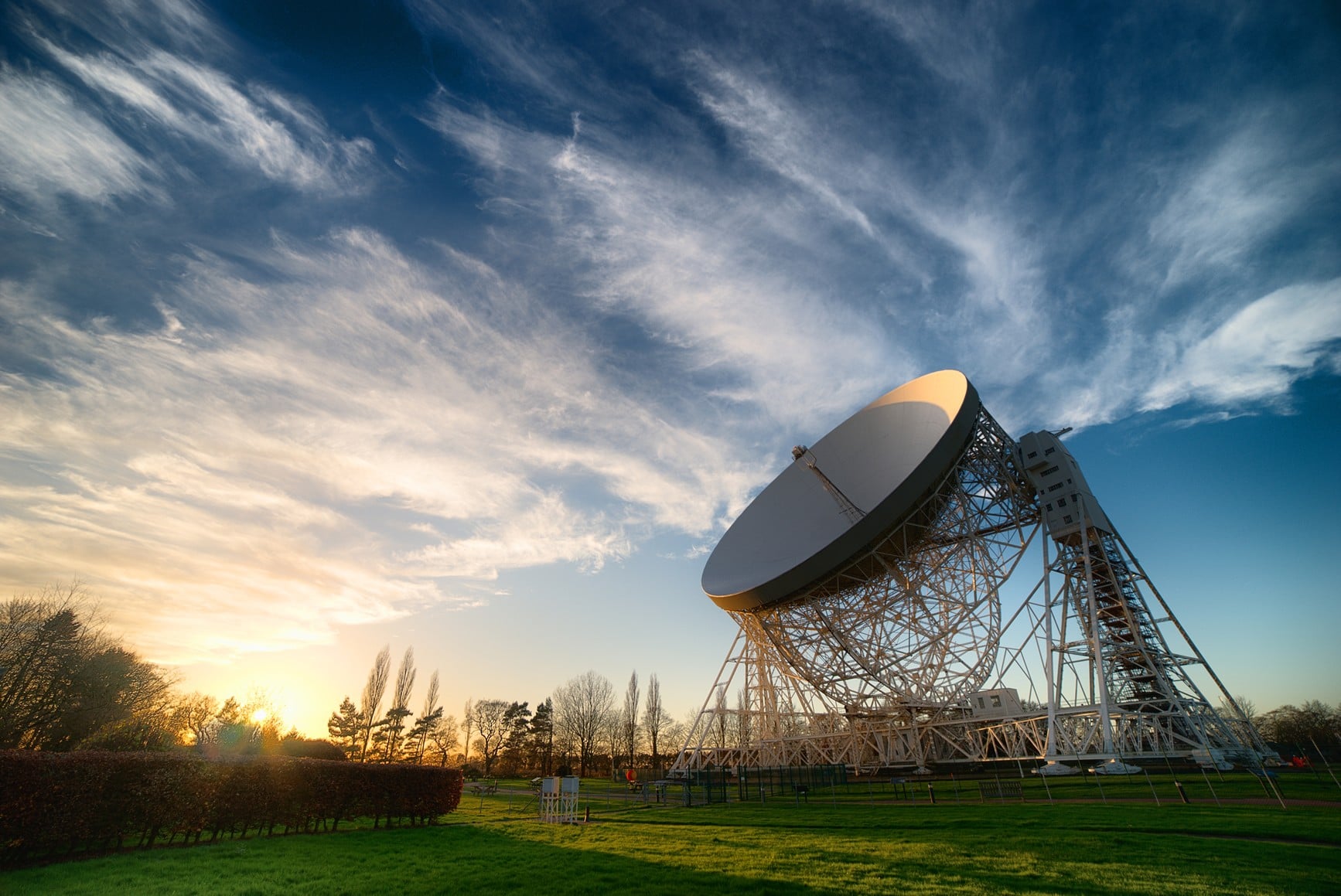
Tracking Satellites and Space Debris Using Radio Antennae

The 76-meter Lovell Telescope at Jodrell Bank in the United Kingdom was used as part of a network of telescopes to track space debris using radar techniques. Courtesy Anthony Holloway

Every year, thousands and thousands of satellites get launched into orbit around our planet. The result is an increasingly congested "space" above Earth populated by equipment that provides services to the surface. At the same time, these satellites affect ground-based astronomy research and create potential for damage when they eventually fall through Earth's atmosphere to the ground. In addition, near-Earth space hosts old rocket bodies and other materials left in space by past missions.


from Universe Today https://ift.tt/1qf5gET
via IFTTT

Comments

Popular posts from this blog

A Magnetohydrodynamic Drive Could Lead to Fuel Stations on Mars

Within the next fifteen years, NASA, China, and SpaceX plan to send the first crewed missions to Mars. In all three cases, these missions are meant to culminate in the creation of surface habitats that will allow for many returns and – quite possibly – permanent human settlements. This presents numerous challenges, one of the greatest of which is the need for plenty of breathable air and propellant. Both can be manufactured through electrolysis, where electromagnetic fields are applied to water (H 2 O) to create oxygen gas (O 2 ) and liquid hydrogen (LH 2 ). While Mars has ample deposits of water ice on its surface that make this feasible, existing technological solutions fall short of the reliability and efficiency levels required for space exploration. Fortunately, a team of researchers from Georgia Tech has proposed a “ Magnetohydrodynamic Drive for Hydrogen and Oxygen Production in Mars Transfer ” that combines multiple functionalities into a system with no moving parts. This syst...

SETI Researchers Double-Checked 1 Million Objects for Signs of Alien Signals

We can’t help ourselves but wonder about life elsewhere in the Universe. Any hint of a biosignature or even a faint, technosignature-like event wrests our attention away from our tumultuous daily affairs. In 1984, our wistful quest took concrete form as SETI, the Search for Extraterrestrial Intelligence . Unfortunately, or maybe fortunately, SETI has turned up nothing. Recently, scientists used a powerful new data system to re-examine data from one million cosmic objects and still came up empty-handed. Did they learn anything from this attempt? This effort used COSMIC , which stands for  Commensal Open-Source Multimode Interferometer Cluster . It’s a signal-processing and algorithm system attached to the Karl G. Jansky  Very Large Array  (VLA) radio astronomy observatory. According to SETI, it’s designed to “search for signals throughout the Galaxy consistent with our understanding of artificial radio emissions. “ Modern astronomy generates vast volumes of data and al...

A New Technique Has Dramatically Improved ALMA’s Resolution

To those familiar with optical telescopes, the idea of doing something to achieve higher resolution with their telescope may seem alien, if not, then practically impossible. A telescopes resolution is determined by among other things, its aperture – diameter of the thing that collects light (or electromagnetic radiation) and of course you can’t easily change that. Enter the team at ALMA, the Atacama Large Millimeter Array who have become the first to use the Band 10 receiver and extreme separation of the receivers to boosting its resolution so they can see detail equivalent of detecting a 10 meter long bus on the Moon! The Atacama Large Millimeter/submillimeter Array (otherwise known as ALMA) is based upon interferometer technology which, in its simplest terms, takes a number of telescopes, hooks them together and gives them the same amount of resolution as if the instrument was the same diameter as the distance between the component parts! If that blew your mind then let me explain;...