7-stage journey reveals how falling space rocks survive air

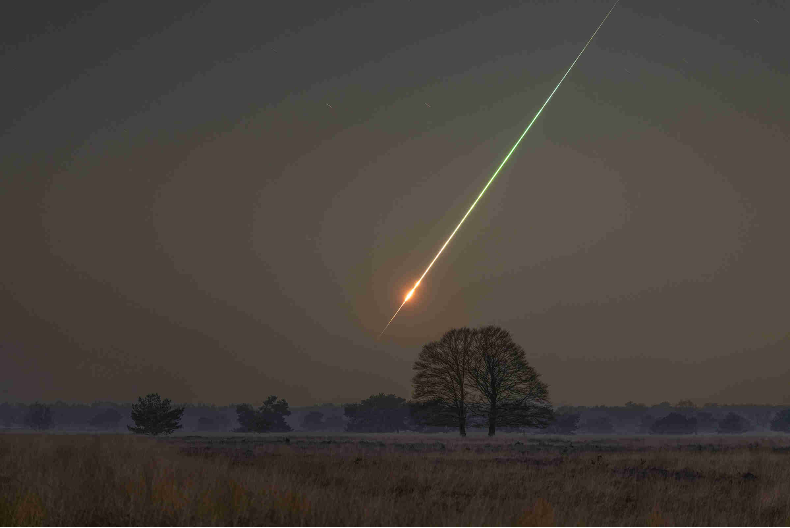
Asteroid 2023 CX1 observed streaking over Normandy, France, on February 13, 2023. The resulting Saint-Pierre-le-Viger meteorite fall was one of 75 analyzed in this study conducted by the SETI Institute and NASA Ames Research Center. (Photo Credit: G. de Reijke)

At least once in our lives, we’ve all seen a bright streak of light briefly blaze across the sky and have quickly referred to it as an asteroid, meteor, shooting star, comet, or some other whimsical name we’ve heard others use to describe it. For those calling it a meteor, you would be correct, but we’ll touch upon this later. The time it takes for a space rock, bolide being its scientific name, to travel through Earth's atmosphere and crash into the ground literally takes only a few seconds. But what happens to a space rock during this very brief travel time, and how can scientists use this to learn about a specific space rock’s origin and the potential damage it could cause if it explodes in mid-air?


from Universe Today https://ift.tt/769a2Nx
via IFTTT

Comments

Popular posts from this blog

More Data and Machine Learning has Kicked SETI Into High Gear

For over sixty years, astronomers and astrophysicists have been engaged in the Search for Extraterrestrial Intelligence (SETI). This consists of listening to other star systems for signs of technological activity (or “technosignatures), such as radio transmissions. This first attempt was in 1960, known as Project Ozma, where famed SETI researcher Dr. Frank Drake (father of the Drake Equation) and his colleagues used the Robert C. Byrd Green Bank Telescope in West Virginia to conduct a radio survey of Tau Ceti and Epsilon Eridani. Since then, the vast majority of SETI surveys have similarly looked for narrowband radio signals since they are very good at propagating through interstellar space. However, the biggest challenge has always been how to filter out radio transmissions on Earth – aka. radio frequency interference (RFI). In a recent study, an international team led by the Dunlap Institute for Astronomy and Astrophysics (DIAA) applied a new deep-learning algorithm to data collecte...

The First Close-Up Picture of Star Outside the Milky Way

Like a performer preparing for their big finale, a distant star is shedding its outer layers and preparing to explode as a supernova. Astronomers have been observing the huge star, named WOH G64, since its discovery in the 1970s. It’s one of the largest known stars, and also one of the most luminous and massive red supergiants (RSGs). The star is surrounded by an envelope of expelled star-stuff, which could indicate it’s getting ready to explode. WOH G64 isn’t in the Milky Way; it’s in the Large Magellanic Cloud (LMC), the Milky Way’s largest satellite galaxy. Getting these detailed image is quite a feat for the ESO’s Very Large Telescope Interferometer. It’s also quite an accomplishment for the team of scientists behind the image. They’ve published their images and the results of their observations of the star in the journal Astronomy and Astrophysics. Their research is titled “ Imaging the innermost circumstellar environment of the red supergiant WOH G64 in the Large Magellanic ...

eROSITA Sees Changes in the Most Powerful Quasar

After almost seventy years of study, astronomers are still fascinated by active galactic nuclei (AGN), otherwise known as quasi-stellar objects (or “quasars.”) These are the result of supermassive black holes (SMBHs) at the center of massive galaxies, which cause gas and dust to fall in around them and form accretion disks. The material in these disks is accelerated to close to the speed of light, causing it to release tremendous amounts of radiation in the visible, radio, infrared, ultraviolet, gamma-ray, and X-ray wavelengths. In fact, quasars are so bright that they temporarily outshine every star in their host galaxy’s disk combined. The brightest quasar observed to date, 100,000 billion times as luminous as our Sun, is known as SMSS J114447.77-430859.3 (J1144). This AGN is hosted by a galaxy located roughly 9.6 billion light years from Earth between the constellations Centaurus and Hydra. Using data from the eROSITA All Sky Survey and other space telescopes, an international t...