Asteroids' Oddball Shapes Make Deflecting Them Challenging

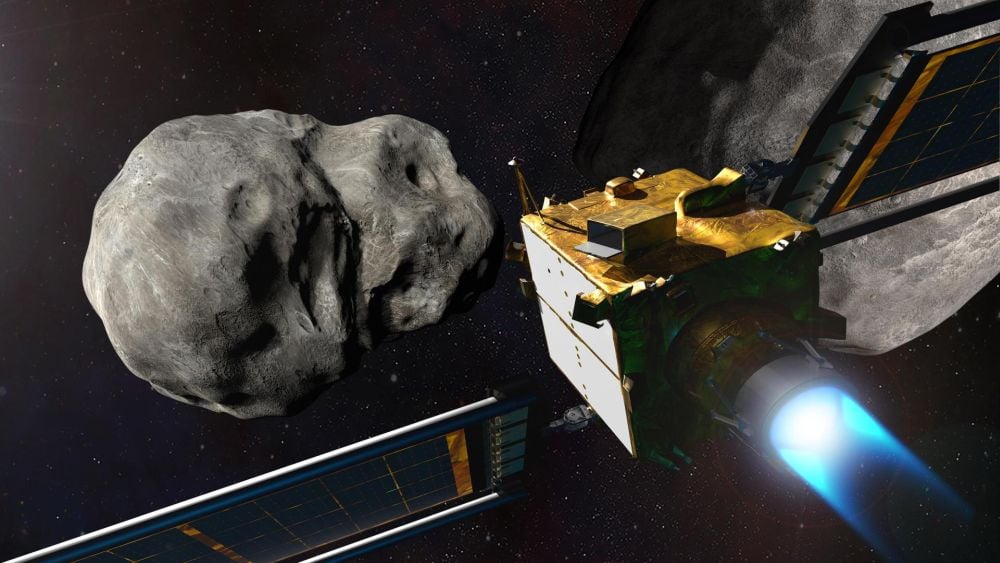
This artist's illustration shows NASA's Double Asteroid Redirection Test spacecraft approaching its target, Dimorphos. If we need to deflect an incoming asteroid on short notice, an impactor like DART won't do the job. We may need to redirect the dangerous rock with an x-ray pulse from a carefully detonated nuclear weapon. But the part of the surface we direct the x-ray pulse at matters a lot. Image Credit: NASA/Johns Hopkins APL/Steve Gribben

In a pinch, we could use a stand-off nuclear blast to redirect a dangerous asteroid on short notice. There's no atmospheric shock wave in space, but the x-ray pulse could still deflect the space rock. But asteroids aren't round and uniform, so their weird shapes make it difficult.


from Universe Today https://ift.tt/xKRET8y
via IFTTT

Comments

Popular posts from this blog

Do Dwarf Galaxies Merge In The Milky Way's Halo?

Our current understanding of the Cosmos shows that structures emerge hierarchically. First there are dark matter densities, then dwarf galaxies. Those dwarfs then merge to form more massive galaxies, which merge together into even larger galaxies. Evidence of dwarf galaxy mergers is difficult to obtain, but new research found some in the Milky Way's halo. from Universe Today https://ift.tt/DXpfOim via IFTTT

SETI Researchers Double-Checked 1 Million Objects for Signs of Alien Signals

We can’t help ourselves but wonder about life elsewhere in the Universe. Any hint of a biosignature or even a faint, technosignature-like event wrests our attention away from our tumultuous daily affairs. In 1984, our wistful quest took concrete form as SETI, the Search for Extraterrestrial Intelligence . Unfortunately, or maybe fortunately, SETI has turned up nothing. Recently, scientists used a powerful new data system to re-examine data from one million cosmic objects and still came up empty-handed. Did they learn anything from this attempt? This effort used COSMIC , which stands for  Commensal Open-Source Multimode Interferometer Cluster . It’s a signal-processing and algorithm system attached to the Karl G. Jansky  Very Large Array  (VLA) radio astronomy observatory. According to SETI, it’s designed to “search for signals throughout the Galaxy consistent with our understanding of artificial radio emissions. “ Modern astronomy generates vast volumes of data and al...

A Magnetohydrodynamic Drive Could Lead to Fuel Stations on Mars

Within the next fifteen years, NASA, China, and SpaceX plan to send the first crewed missions to Mars. In all three cases, these missions are meant to culminate in the creation of surface habitats that will allow for many returns and – quite possibly – permanent human settlements. This presents numerous challenges, one of the greatest of which is the need for plenty of breathable air and propellant. Both can be manufactured through electrolysis, where electromagnetic fields are applied to water (H 2 O) to create oxygen gas (O 2 ) and liquid hydrogen (LH 2 ). While Mars has ample deposits of water ice on its surface that make this feasible, existing technological solutions fall short of the reliability and efficiency levels required for space exploration. Fortunately, a team of researchers from Georgia Tech has proposed a “ Magnetohydrodynamic Drive for Hydrogen and Oxygen Production in Mars Transfer ” that combines multiple functionalities into a system with no moving parts. This syst...